
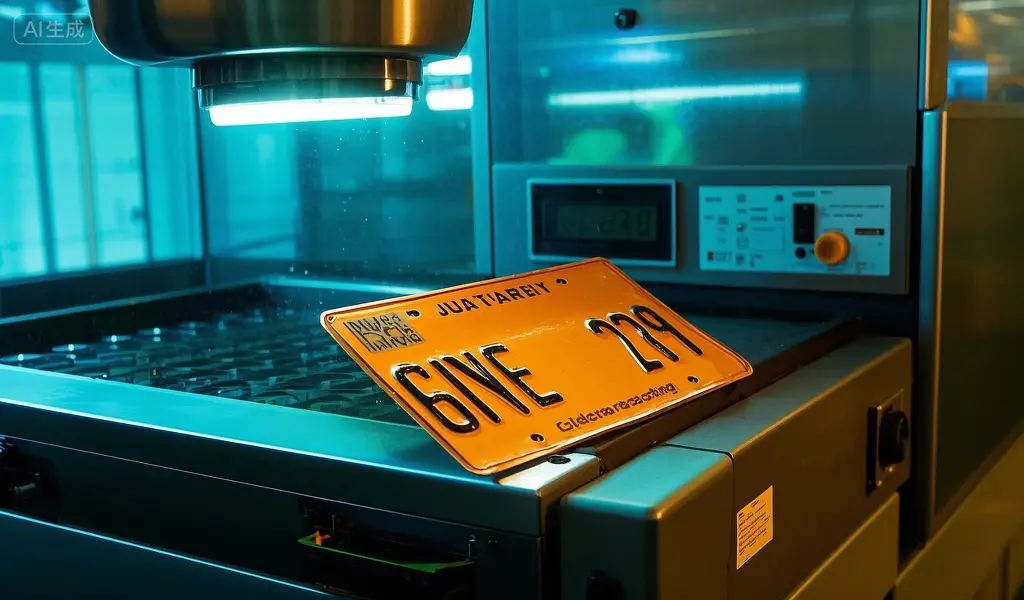
Automatic License Plate Production Line
The complete guide for new plate factories — from metal coil to finished plates, fully automated.
Introduction
An automatic license plate production line is a fully integrated system that transforms raw metal coils into finished, compliant license plates through automated processes. Unlike traditional semi-manual approaches, a modern automatic license plate production line consolidates all steps into one continuous, synchronized workflow.
This guide is designed for procurement managers, plant engineers, and business owners planning a new license plate production plant, upgrading from semi-automatic equipment, or establishing a centralized production center.
Key pain points this guide addresses:
- High manual labor costs and limited scalability
- Quality inconsistencies across batches
- Inability to meet growing demand
- Compliance complexity with evolving traffic regulations
What Is an Automatic License Plate Production Line?
An automatic license plate production line eliminates inefficiencies by integrating all processes into a single, continuous system. Material flows automatically from the decoiler through laminating, servo-controlled feeding, stamping, embossing, hot stamping or printing, and final inspection, with automatic stacking and palletizing at the end.
Key Advantages
- Continuous Production: Material flows without interruption, maximizing throughput
- Higher Capacity: 300–1,500+ plates per hour
- Stable Quality: Automated processes reduce human error
- Reduced Labor: 1–2 operators vs 5–10 traditionally
- Flexibility: Easy recipe changes for different plate sizes
- Compliance Ready: Built-in traceability and quality logging
Key Components of a License Plate Production Line
Choosing the right combination of machines is critical for performance and flexibility.
Decoiler & Straightener
Unwinds raw metal coil stock and removes inherent curvature. Essential for downstream stamping accuracy and film adhesion.
- Coil weight: 500–2,000 kg
- Width: 300–600 mm
- Thickness: 0.8–2.0 mm
Film Laminating Machine
Applies reflective film, colored film, or protective coatings under controlled heat and pressure. Critical for a reflective license plate production line.
- Temperature: 60–120°C
- Pressure: measured in bar or PSI
- Speed: synchronized with line
Servo Roll Feeder
Controls the precise length of material fed to the stamping press each cycle, synchronized with the press stroke.
Stamping / Blanking Press
Cuts the continuous metal strip into individual plate blanks, forming shape, mounting holes, and corner radii in a single stroke.
- Tonnage: 100–300 tons
- Custom dies per plate standard
Embossing Press
Applies character dies to create legible, tactile numbers and letters. Depth and positioning are critical for compliance.
Hot Stamping / Printing Unit
Applies colored ink, borders, and logos using heat and pressure. Ensures excellent ink adhesion and outdoor durability.
Conveyors, Stacking & Control System
The PLC/HMI control system orchestrates all machines, monitors quality, logs production data, and alerts operators to anomalies.
Step-by-Step Production Process
Step 1 – Material Loading, Uncoiling and Leveling
Raw metal coil is loaded onto the decoiler using a coil cart or overhead crane. The straightening unit removes any curvature or waviness. Flatness is critical because any deviation propagates through the entire line, affecting stamping accuracy, hole positioning, and film adhesion.
Step 2 – Surface Cleaning and Film Laminating
The metal surface is cleaned to remove oils, dust, and oxidation, then dried before the laminating unit applies reflective or colored film under controlled heat and pressure.
Step 3 – Coil Feeding into the Stamping Press
The servo feeder receives a recipe from the PLC and advances the material strip by the exact length needed for one plate blank, synchronized with the press cycle.
Step 4 – Blanking: Cutting Coil into License Plate Blanks
The stamping press cuts the material into individual plate blanks. In a single stroke, the tooling forms the plate outline, mounting holes, corner radii, and embossed features.
Step 5 – Embossing of Numbers and Letters
Character dies apply raised or recessed numbers and letters. Embossing depth and character clarity are essential for readability and compliance.
Step 6 – Hot Stamping / Printing of Characters and Borders
Colored ink is applied using heated dies or a printing head. Temperature, pressure, and dwell time are carefully controlled to ensure vibrant colors and excellent ink adhesion.
Step 7 – Final Inspection, Packing and Palletizing
Plates undergo final inspection for dimensions, surface finish, film adhesion, and character clarity. Passing plates are automatically stacked and palletized; defective plates are diverted for rework or scrap.
Technical Specifications to Consider
When evaluating an automatic license plate production line, understanding key technical specifications helps you select the right system.
Plate Size and Thickness
Support multiple sizes: European (520×110 mm), US (305×152 mm), Asian variants. Thickness: 0.8 mm (aluminum) to 2.0 mm (steel).
Line Speed and Capacity
Typical lines produce 300–800 plates/hour for standard designs, up to 1,500+ for simpler blanks without embossing.
Power and Air Consumption
30–80 kW electrical power; 5–10 m³/min compressed air at 6–8 bar.
Operators Required
Only 1–2 operators per shift for a fully automatic license plate production line.
Quality Control in License Plate Production
Quality is non-negotiable in license plate manufacturing. Here is how a modern automatic license plate production line ensures quality at every stage:
Dimensional Accuracy
Typical tolerances: ±0.5 mm overall dimensions, ±0.2 mm hole positions.
Film Adhesion and Durability
Reflective film adhesion verified through peel tests and accelerated weathering tests.
Embossing Depth and Legibility
Embossing depth measured and logged for every batch. Character legibility verified under standard lighting.
Surface Defects and Color
Automated vision systems detect surface defects; ink temperature and pressure control color consistency.
Traceability and Batch Management
Every plate assigned a batch number and production timestamp for full traceability.
Investment, Price and ROI
Upfront Investment
- Machines and Equipment: EUR 200,000–600,000
- Tooling: EUR 20,000–100,000
- Installation and Commissioning: EUR 30,000–80,000
- Training: EUR 5,000–15,000
An automatic license plate production line typically pays for itself in 2–4 years through labor savings, increased capacity, and reduced scrap.
How to Choose a License Plate Production Line Supplier
Selecting the right supplier is as important as selecting the right equipment.
Certifications and Compliance
- ISO 9001 (Quality Management System)
- CE Marking (European safety standards)
- Compliance with traffic regulations in your target markets
Experience and References
Ask for references from existing customers. A supplier with 10+ years of experience and 50+ installations worldwide is more reliable than a newcomer.
After-Sales Service
- Remote support via phone, email, or video call
- On-site response within 24–48 hours for critical issues
- Common spare parts in stock or available within days
Customization and Upgrades
Can the supplier customize the line for your specific plate standards? Can it be upgraded later with embossing, personalization, or other features?
Conclusion & Call to Action
An automatic license plate production line is a transformative investment for any new or expanding license plate manufacturing facility. By consolidating all production steps into a single, synchronized system, you gain high-quality output at scale with minimal labor and full regulatory compliance.
- Higher Capacity: 300–1,500+ plates per hour
- Superior Quality: Consistent dimensions, colors, and durability
- Lower Labor Costs: Reduce staff from 8–10 to just 1–2 operators
- Regulatory Compliance: Built-in traceability and quality logging
- Rapid ROI: Payback in 2–4 years through labor and efficiency gains
Reach out to our team for a free layout proposal and quotation tailored to your license plate standards.