

Choosing the Right Reflective Sheeting: A Comprehensive Guide
Choosing reflective sheeting sounds simple until you realize there are multiple grades, two major classification systems, and significant performance differences that aren’t visible in daylight. Pick the wrong grade and your signs fail inspection. Pick the right grade without verifying supplier quality, and you still end up replacing signs early.
To choose the right reflective sheeting, match the sheeting grade to your application requirements using the ASTM D4956 type system (Type I through Type XI) or the European EN 12899 RA classification (RA1, RA2, RA3). The three key decision factors are required retroreflective brightness for the sign’s viewing distance and speed environment, outdoor durability for the installation climate, and standards compliance for the governing specification.
This guide walks through each decision factor in practical terms — how the grades actually differ, which standards apply, how to compare products across brands and suppliers, and what to verify before committing to a purchase. Whether you’re a sign manufacturer, an importer sourcing from overseas factories, or a procurement team specifying materials for a DOT project, the goal is the same: choose a sheeting that performs, complies, and lasts.
This article is based on direct experience specifying and sourcing reflective sheeting for traffic sign, vehicle marking, and industrial safety applications across multiple markets and standards frameworks.
What Is the Difference Between Engineer Grade, High Intensity Prismatic, and Diamond Grade?
This is where every sheeting selection decision starts, and getting the grade wrong is the most common — and most expensive — mistake buyers make.
Engineer Grade (ASTM Type I) uses glass bead technology and is the least bright. High Intensity Prismatic (Type III/IV) uses microprismatic or enclosed lens elements and is 2–3x brighter. Diamond Grade (Type IX/XI) uses full cube microprismatic technology and is 6–10x brighter, with superior wide-angle performance for large and overhead signs.

Engineer Grade is the entry-level option. Glass beads embedded in the sheeting surface reflect light back toward the driver, but the effect drops off quickly at longer distances and wider viewing angles. It’s appropriate for low-speed environments — residential street signs, parking lot signs, property markers, and non-critical informational signs. Typical outdoor durability is around 7 years. The cost is the lowest of any grade, which makes it attractive for high-volume, low-criticality applications.
High Intensity Prismatic (HIP) is the standard workhorse for public road signage. Type III uses encapsulated glass bead (enclosed lens) construction, while Type IV uses true microprismatic elements. Both deliver substantially better nighttime visibility than engineer grade and are specified by most DOTs as the minimum acceptable grade for regulatory signs (speed limits, stop signs, yield signs) and warning signs on public highways. Durability ratings are typically 10–12 years.
Diamond Grade is the premium performance tier. Type IX uses truncated cube corner prisms, while Type XI uses full cube corner technology. The practical difference is dramatic: diamond grade sheeting remains readable at distances and angles where lower grades effectively disappear. It’s specified for overhead guide signs, large-format direction signs, signs in complex interchange areas, and any location where maximum visibility saves lives. Durability reaches 12+ years.
The decision framework is straightforward:
Low speed, short viewing distance, non-critical → Engineer Grade (Type I)
Highway speed, standard regulatory/warning signs → High Intensity Prismatic (Type III/IV)
Overhead, large-format, long-distance, critical safety → Diamond Grade (Type IX/XI)
Over-specifying wastes budget. Under-specifying risks inspection failure and safety liability. The right choice is always driven by the specific application, not by price preference.
How Do ASTM D4956 and EN 12899 Determine Which Grade You Need?
If someone tells you to “just pick the brightest one,” they don’t understand how reflective sheeting procurement actually works. Standards determine what you need — not preference.
ASTM D4956 classifies sheeting into types (I through XI) with defined minimum retroreflectivity values. EN 12899 uses RA classes (RA1, RA2, RA3) for the same purpose in Europe. The specification governing your project determines which type or class is required — and supplying the wrong one means rejection.
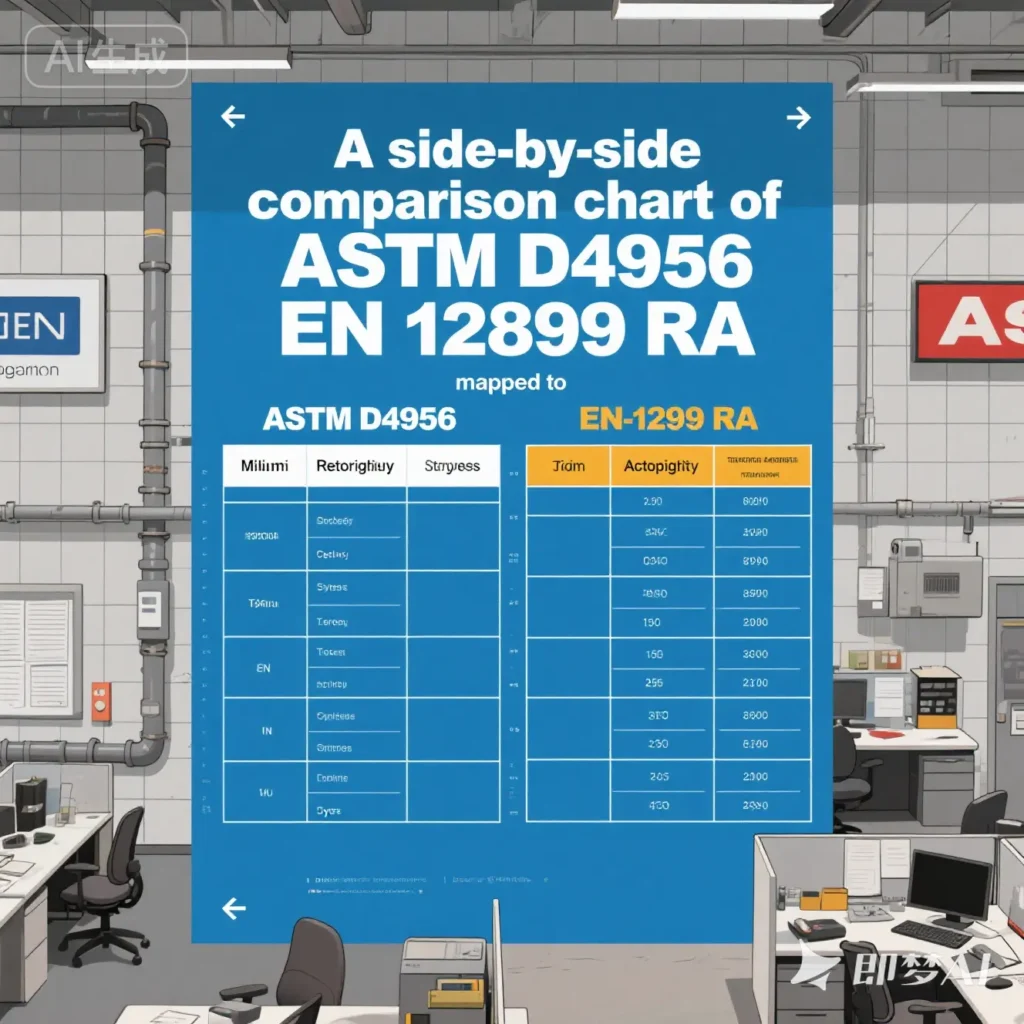
Here’s the practical mapping:
Application ASTM D4956 Type EN 12899 Class Notes Parking, residential, low-speed Type I RA1 Minimum acceptable for non-highway
Highway regulatory and warning Type III / IV RA2 Most common DOT/road authority spec
Construction zone (fluorescent) Type VIII — Fluorescent + prismatic
Overhead guide signs, Type IX RA3 Standard for motorway direction signs.
Large/critical signs, wide-angle Type XI RA3 (premium) Full cube technology
How to use this in practice:
Step 1: Identify the governing standard. If you’re making signs for a US DOT project, it’s ASTM D4956. For European road signs, it’s EN 12899. For vehicle conspicuity markings, it’s typically ECE R104.
Step 2: Check the project specification for the required type or class number. This is usually stated in the bid document, sign schedule, or material specification section.
Step 3: Source sheeting that explicitly meets that type or class. Not “similar to” or “equivalent” — the actual ASTM type or EN class designation must appear on the manufacturer’s product data sheet.
One critical nuance: RA2 in Europe is not identical to Type III in the US. The minimum retroreflectivity values and test angle configurations differ between the two standards. A product certified to ASTM D4956 Type III may or may not meet EN 12899 RA2 requirements at all specified angles. If you’re supplying to both markets, verify compliance against each standard independently.
Assuming ASTM and EN classifications are interchangeable is a common procurement error. Always verify against the specific standard that governs your project.
What Is the Real Difference Between 3M HIP and Diamond Grade — and Does the Premium Matter?
This is one of the most searched comparisons in the reflective sheeting space, and the answer depends entirely on where the sign will be installed.
3M HIP (High Intensity Prismatic) meets ASTM D4956 Type III/IV and is designed for standard highway signs. 3M DG3 (Diamond Grade) meets Type IX/XI and delivers 2–4x higher retroreflectivity, with significantly better wide-angle and long-distance performance — making it essential for overhead, large-format, and high-speed critical signs.
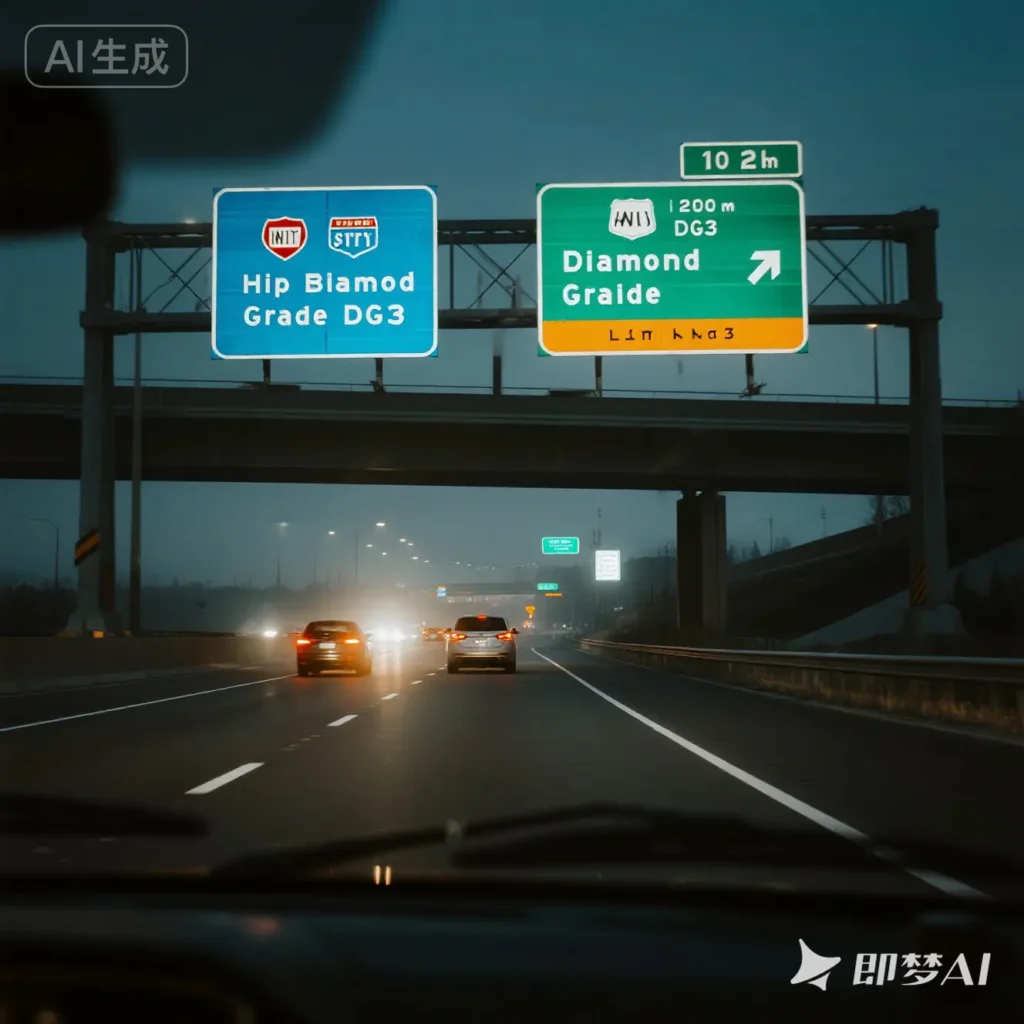
Here’s where the premium matters and where it doesn’t:
HIP is the right choice when: The sign is standard size (up to about 1.2m × 1.5m) Mounted at standard height (2–3 meters) On a road with speed limits up to about 100 km/h The specification calls for Type III or Type IV In these conditions, HIP delivers more than adequate nighttime visibility. Upgrading to diamond grade would add cost without meaningful safety benefit.
Diamond Grade is the right choice when:
The sign is large-format (overhead guide signs, direction panels) Mounted at significant height (5+ meters) On high-speed roads (100+ km/h) where drivers need to read from 200+ meters
Truck drivers are a significant portion of traffic (steep vertical viewing angles)
The specification calls for Type IX or Type XI
The reason diamond grade matters in these situations is physics: at wide entrance angles and long viewing distances, the retroreflective efficiency of HIP drops off substantially, while diamond grade — especially Type XI full cube — maintains high brightness. For a truck driver approaching an overhead sign at highway speed, this can be the difference between reading the sign in time and missing the exit.
The cost difference between HIP and diamond grade is typically 2x to 3x per square meter. For a standard roadside sign, that premium is hard to justify. For a large overhead sign where visibility directly affects safety, it’s a straightforward decision.
This comparison applies broadly, not just to 3M products. Avery Dennison, Orafol, and qualified Chinese manufacturers all offer products across these same performance tiers. The physics of the comparison — prismatic vs. full cube, standard angle vs. wide angle — remain the same regardless of brand.
The HIP vs. Diamond Grade decision should be driven by sign size, mounting height, and viewing distance — not by brand preference or budget pressure alone.
What Should You Verify Before Committing to a Reflective Sheeting Purchase?
Choosing the right grade is only half the decision. The other half is making sure the product you receive actually performs at the level you specified.
Before committing, verify four things: the specific ASTM or EN type designation on the data sheet, third-party retroreflectivity test values at standard angles, accelerated weathering durability data, and real-world adhesive performance on your actual sign substrates.
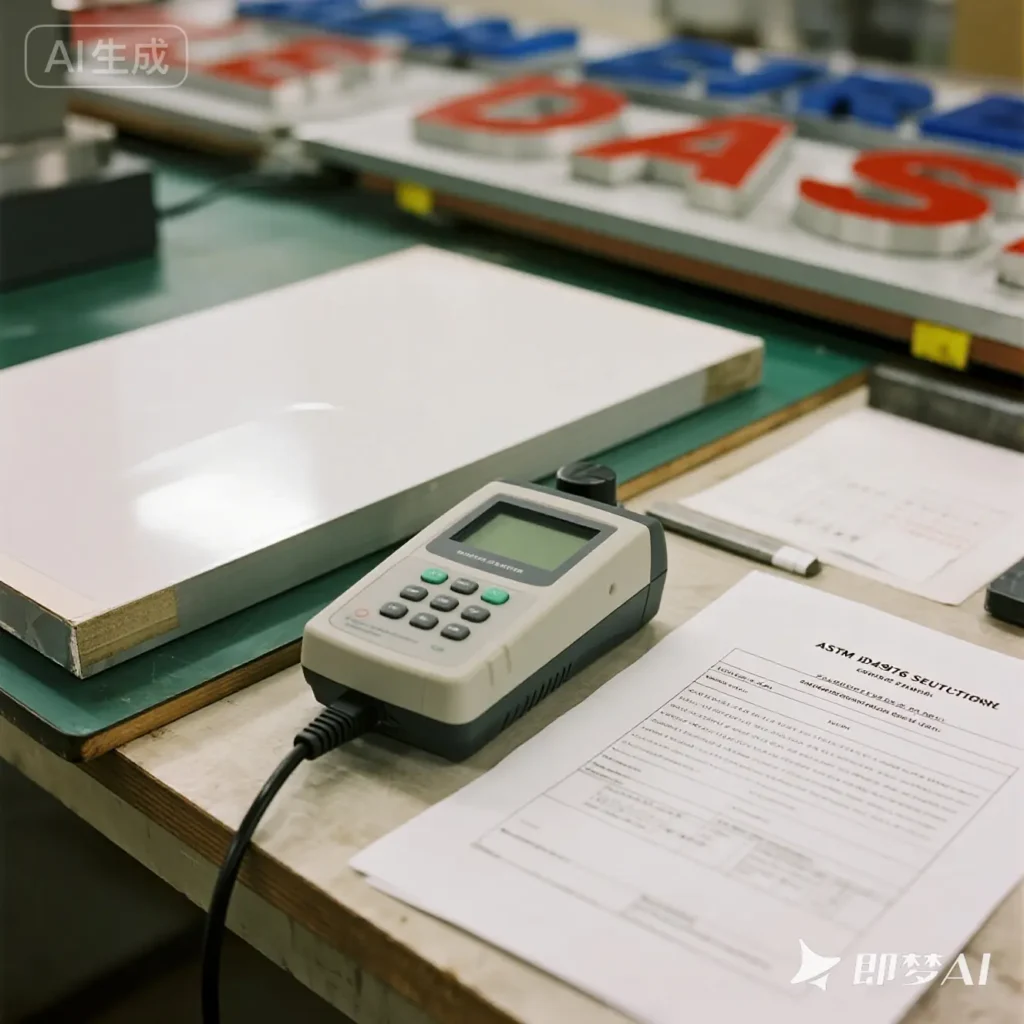
- Confirm the ASTM or EN designation — not marketing language. A product described as “high intensity” or “premium prismatic” without a specific Type III, Type IV, or RA2 designation is ambiguous. Reputable manufacturers always state the exact standard and type their product meets. If the data sheet is vague, press for specifics before proceeding.
- Request measured retroreflectivity values. Ask for test results at the standard ASTM observation angle (0.2°) and entrance angle (−4°). Compare the reported values against the ASTM D4956 or EN 12899 minimum requirements for the claimed type. If a product claims Type IV but shows retroreflectivity values barely above Type I minimums, it’s not a genuine Type IV product.
- Check outdoor durability evidence. A claimed 10-year lifespan needs to be backed by accelerated weathering test data — not just a marketing statement. This is particularly important if the sheeting will be used in tropical, desert, or high-UV coastal environments where degradation happens faster than the manufacturer’s temperate-climate assumptions.
- Test adhesive performance yourself. Even if the reflective layer is excellent, adhesive failure — edge lifting, bubbling, delamination — will ruin the sign. Apply samples to your actual sign substrates (aluminum blanks, composite panels, or whatever you use) and evaluate adhesion after 24–72 hours under realistic temperature conditions. This step catches more problems than any amount of data sheet review.
- For new suppliers: request samples and test independently. If you’re evaluating a supplier you haven’t worked with before, always request production-representative samples (not special “sample quality” runs) and measure retroreflectivity yourself with a handheld retroreflectometer. This single step prevents more procurement failures than all other verification steps combined.
The most expensive reflective sheeting mistake is not buying the wrong grade — it’s failing to verify that the product you received actually matches the grade you specified.
Conclusion
Choosing the right reflective sheeting comes down to three decisions made in order: identify the correct grade for your application, confirm compliance with the governing standard, and verify actual product performance before committing to volume.
The grade decision is driven by sign size, mounting height, viewing distance, and traffic speed. The standard decision is driven by the project specification — ASTM D4956 in the US, EN 12899 in Europe, ECE R104 for vehicle markings. And the verification decision is driven by common sense: measure, test, and confirm before you scale.
Whether you’re sourcing from 3M, Avery Dennison, Orafol, or a qualified Chinese manufacturer, the evaluation framework is the same. The brand on the box doesn’t guarantee performance — the test data does.
ASTM D4956 Standard Specification
FHWA Sign Retroreflectivity Requirements
EN 12899-1 European Standard for Fixed Traffic Signs
3M Reflective Sheeting Product Selector
FAQs
What is the difference between Class 1 and Class 2 reflective signs?
Class 1 and Class 2 are classifications used in some regional standards (particularly in Australia and parts of Asia) to define reflective sign performance levels. Class 1 is the higher-performing class, typically requiring retroreflectivity equivalent to ASTM D4956 Type IX or higher — used for highway and high-speed road signs. Class 2 is the lower-performing class, roughly equivalent to Type I or Type III, used for low-speed and supplementary signs. Always check which specific standard your project references, as “Class 1” and “Class 2” definitions vary between countries.
What is the difference between RA1 and RA2 reflective sheeting?
RA1 and RA2 are retroreflective performance classes defined by the European standard EN 12899-1. RA1 corresponds roughly to ASTM D4956 Type I (engineer grade) and is acceptable for low-speed, supplementary signs. RA2 corresponds roughly to Type III/IV (high intensity prismatic) and is the standard minimum for highway regulatory and warning signs across most European road networks. The practical difference is significant: RA2 sheeting is approximately 2.5–3x brighter than RA1 at night, making it readable from substantially greater distances.
What are the rules for reflective tape on vehicles?
Vehicle reflective tape (conspicuity markings) is regulated by ECE R104 in Europe and most international markets, and by FMVSS 108 in the United States. These regulations specify the minimum retroreflective performance, color (typically alternating red and white, or solid yellow/white), placement positions, and dimensions for trucks, trailers, and other heavy vehicles. The reflective tape must meet defined retroreflectivity values and must be applied in specific patterns — rear, side, and sometimes front marking positions. Always check the specific regulation that applies in your destination market.
How long does reflective sheeting last outdoors?
Outdoor durability depends on the grade and the installation environment. Engineer grade (Type I) typically lasts around 7 years. High intensity prismatic (Type III/IV) is usually rated for 10–12 years. Diamond grade (Type IX/XI) can last 12+ years. These ratings assume temperate climate conditions. In tropical, desert, or coastal environments with high UV exposure, salt air, or extreme temperature cycles, actual lifespan may be 20–40% shorter. Always request the manufacturer’s accelerated weathering test data for the specific product you’re purchasing.
Is it worth paying more for diamond grade reflective sheeting?
It depends on the application. For standard roadside signs at normal mounting heights, high intensity prismatic (Type III/IV) is the cost-effective choice and meets most DOT specifications. For overhead guide signs, large-format direction panels, signs on high-speed motorways, and critical warning signs — especially where truck traffic is heavy — diamond grade (Type IX/XI) provides measurably better visibility and is often required by specification. The cost premium is typically 2–3x per square meter, which is justified when sign size, viewing distance, and safety criticality warrant it.