

Reflective sheeting looks simple from the outside — a bright, flexible film applied to traffic signs, vehicles, or safety products. But inside that film is a carefully engineered optical system designed to return light back toward its source, helping drivers see signs and markings at night.
Reflective sheeting is made by building multiple layers of optical film, adhesive, reflective elements, and protective surfaces into one durable sheet. The main production methods use either glass bead technology, where tiny microspheres focus light onto a reflective layer, or microprismatic technology, where precisely formed cube-corner prisms redirect light back toward the driver.
The exact manufacturing process depends on the grade and application. Engineer grade sheeting is usually bead-based, while high intensity and diamond grade sheeting rely on more advanced microprismatic structures. Understanding how reflective sheeting is made helps buyers evaluate quality, compare suppliers, and avoid products that look acceptable in daylight but fail in real nighttime conditions.
This article is written from direct industry experience with retroreflective materials used in traffic signs, vehicle markings, safety tapes, and license plate applications.
What Is Reflective Sheeting Made Of?
Reflective sheeting is not a single-layer sticker. It is a multi-layer material designed to reflect light, resist weathering, bond to a surface, and maintain visibility for years outdoors.
Reflective sheeting is typically made of a face film, retroreflective optical elements, a reflective or air-backed layer, adhesive, and a release liner. Depending on the grade, the optical elements may be glass beads, microprisms, or full cube prisms, which determine how much light is returned to the driver.
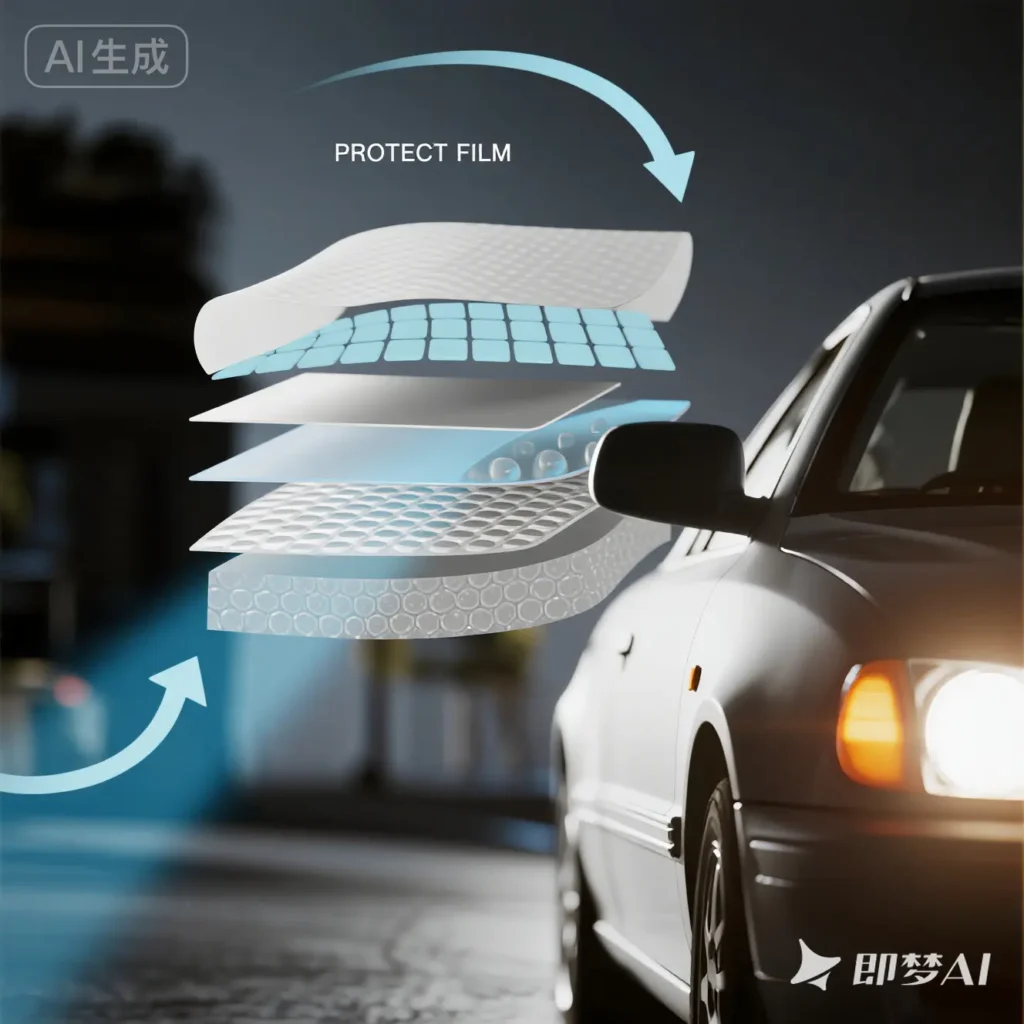
The top layer is usually a weather-resistant transparent film. It protects the optical system from UV exposure, rain, dust, road salt, and abrasion. For traffic signs, this top film must stay clear and stable because any yellowing, cracking, or surface damage reduces night visibility.
Below that layer are the retroreflective elements. In glass bead sheeting, these are tiny transparent microspheres. In prismatic sheeting, they are precisely molded geometric structures. Their job is to redirect incoming light back toward the light source instead of scattering it in all directions.
The next layer depends on the technology. Glass bead sheeting often uses a metallic or reflective backing layer. Some prismatic films use an air-backed structure, where the prism geometry works with an air interface to create total internal reflection. Premium full cube materials are engineered to return more light with less optical loss.
Under the reflective system is the adhesive. For sign production, pressure-sensitive adhesive is common because it allows the sheeting to bond to aluminum, steel, or other sign substrates. Finally, the release liner protects the adhesive before application and is removed during lamination.
The optical layer determines brightness, but the face film and adhesive often determine real-world durability. A product can have good initial reflectivity and still fail early if the surface film or adhesive system is weak.
How Are Glass Bead and Microprismatic Reflective Sheetings Produced?
The two main manufacturing routes are glass bead construction and microprismatic construction. Both create retroreflection, but they do it through very different optical designs.
Glass bead reflective sheeting is made by coating or embedding tiny glass microspheres into a film structure, while microprismatic reflective sheeting is made by embossing or casting precise cube-corner prism patterns into a polymer film. Glass bead sheeting is generally simpler and lower cost; microprismatic sheeting is brighter and more suitable for high-performance traffic signs.

For glass bead sheeting, production usually begins with a carrier film or backing layer. A resin or binder coating is applied, and glass beads are distributed evenly across the surface. The beads must be controlled in size, clarity, roundness, and distribution. If the beads are inconsistent, the finished sheeting will have uneven brightness.
In enclosed lens or engineer grade products, beads are embedded into the film with a reflective layer behind them. Light passes through the bead, focuses onto the reflective backing, and returns toward the source. This design is effective, but it loses more light than prismatic systems and is more limited at wider viewing angles.
For microprismatic sheeting, the manufacturing process is more precision-driven. A transparent polymer film is cast, embossed, or cured against a master mold containing thousands or millions of tiny cube-corner prism patterns. Each prism must have accurate geometry, sharp edges, and consistent depth. Small deviations in prism shape can reduce brightness significantly.
After the prism layer is formed, it is laminated with additional layers such as a face film, sealing layer, adhesive, and liner. Some prismatic products use cells or sealed air spaces behind the prisms to preserve optical performance. High-end products such as diamond grade or Type XI full cube sheeting require especially precise tooling because the prism geometry is responsible for wide-angle and long-distance brightness.
Microprismatic sheeting is not simply “brighter plastic.” Its performance depends on mold precision, polymer clarity, prism geometry, sealing quality, and lamination control across the full roll width.
What Manufacturing Steps Affect Reflective Sheeting Quality the Most?
Not every production step has the same impact on final performance. Some steps mainly affect appearance, while others directly determine whether the sheeting will meet standards after years outdoors.
The most critical manufacturing steps are optical element formation, coating uniformity, lamination control, adhesive application, curing, and final retroreflectivity testing. Problems in any of these steps can cause low brightness, poor color consistency, edge lifting, delamination, or premature weathering failure.

The first critical step is optical formation. For glass bead sheeting, bead size and bead distribution must be consistent. Too many buried beads reduce reflectivity; too many exposed beads can weaken weather resistance. For prismatic sheeting, prism shape and depth must remain uniform across the roll. A small tool defect can create an entire roll with weak retroreflection.
Coating uniformity is another major factor. Resin layers, protective films, and adhesive coatings must be applied at controlled thicknesses. Uneven coating can create cloudy areas, color variation, weak adhesion, or inconsistent retroreflectivity. In traffic sign applications, these differences may not be obvious in daylight but can become obvious under headlights.
Lamination control also matters. Reflective sheeting is built by bonding multiple layers together under heat, pressure, and tension. If tension is wrong, the film can curl, wrinkle, shrink, or distort the optical structure. If heat or pressure is inconsistent, delamination can occur later under outdoor exposure.
Adhesive quality is often underestimated by buyers. Even if the optical layer is good, poor adhesive can cause bubbling, peeling, edge lifting, or failure on aluminum sign blanks. Adhesive performance depends on formulation, coating thickness, liner quality, storage conditions, and compatibility with the substrate.
Finally, reliable manufacturers test finished rolls for retroreflectivity, color, thickness, adhesion, surface defects, shrinkage, and weathering resistance. For traffic-grade products, buyers should expect test data tied to standards such as ASTM D4956, EN 12899, or applicable regional requirements.
Daylight appearance is not enough to judge reflective sheeting quality. The most important defects often show up only through retroreflectivity testing, adhesive testing, or accelerated weathering evaluation.
How Can Buyers Verify Whether Reflective Sheeting Is Well Made?
A buyer does not need to understand every machine on the production line, but they do need a practical way to judge whether a supplier’s product is reliable.
Buyers should verify reflective sheeting quality by checking the claimed standard, reviewing third-party test reports, testing samples with a retroreflectometer, inspecting adhesive performance, and confirming weathering data before placing volume orders. A reliable supplier should be able to provide measurable evidence, not only product photos or general claims.

Start with the product specification. Ask whether the material meets ASTM D4956 Type I, Type III, Type IV, Type VIII, Type IX, or Type XI — or EN 12899 RA1, RA2, or RA3 if your market follows European classifications. Avoid vague descriptions such as “high brightness,” “super grade,” or “similar to 3M” unless they are backed by test values.
Next, request retroreflectivity data. The report should show measured values in cd/lx/m² at standard observation and entrance angles. For ASTM-style testing, values at 0.2° observation and −4° entrance are commonly referenced. If the supplier cannot provide measured values, it is difficult to verify whether the sheeting truly matches the grade claimed.
Check weathering and durability evidence. Traffic sign sheeting is expected to survive years of UV exposure, rain, heat, cold, and pollutants. Ask for accelerated weathering data, outdoor exposure data, or warranty documentation. This is especially important for buyers in tropical, desert, coastal, or high-altitude markets.
Adhesive testing should also be part of supplier evaluation. Apply sample sheeting to the same substrate used in your production, such as aluminum panels or license plate blanks. Look for bubbling, edge lifting, shrinkage, poor initial tack, or residue problems. If you manufacture signs at scale, small adhesive problems can become expensive field failures.
For larger purchases, consider third-party pre-shipment inspection. A qualified inspector can randomly select rolls, measure retroreflectivity, check roll width and length, inspect surface defects, and verify packaging before shipment. This step is especially useful when sourcing from a new supplier.
The best suppliers do not rely on marketing language. They provide product specifications, test data, sample support, warranty terms, and consistent batch quality that buyers can verify before shipment.
Conclusion
Reflective sheeting is made by combining optical engineering, film coating, lamination, adhesive technology, and strict quality control into one functional material. The basic idea is simple — return light toward the driver — but the manufacturing process behind that performance is highly technical.
Glass bead sheeting uses microspheres and reflective backing to produce retroreflection at lower cost. Microprismatic sheeting uses precision-molded cube-corner structures to deliver higher brightness, better long-distance visibility, and stronger wide-angle performance. The quality of the finished product depends not only on the optical design, but also on coating uniformity, lamination accuracy, adhesive strength, and weathering resistance.
For buyers, the key lesson is practical: do not judge reflective sheeting only by appearance or price. Ask how it is made, what standard it meets, what test reports support it, and whether samples perform consistently under real application conditions. A well-made reflective sheeting product should prove its quality through measurable data.
ASTM D4956 Standard Specification for Retroreflective Sheeting
FHWA Sign Retroreflectivity Guidance
EN 12899-1 Fixed Vertical Road Traffic Signs
ISO 15797 Industrial Washing and Finishing Procedures
FAQs
How is reflective material made?
Reflective material is made by combining a transparent surface film, retroreflective optical elements, backing or sealing layers, adhesive, and a release liner. The optical elements are usually glass beads or microprisms. These elements redirect incoming light back toward the source, making the material appear bright under headlights or direct illumination.
What is reflective sheeting made of?
Reflective sheeting is made of several layers: a protective top film, glass beads or microprismatic structures, a reflective or air-backed optical layer, pressure-sensitive adhesive, and a release liner. Traffic-grade products also require weather-resistant films and stable adhesives so the sheeting can survive outdoor exposure for years.
What is the best material for reflective sheeting?
The best material depends on the application. Engineer grade glass bead sheeting is suitable for low-speed or low-cost signs. High intensity prismatic sheeting is better for standard road signs. Diamond grade or Type XI full cube sheeting is best for overhead signs, large guide signs, and high-speed roads where long-distance and wide-angle visibility are critical.
Why is microprismatic reflective sheeting brighter than glass bead sheeting?
Microprismatic sheeting is brighter because cube-corner prism structures return a larger portion of incoming light back toward the source with less optical loss. Glass bead sheeting focuses light through tiny spheres and reflects it from a backing layer, which is effective but less efficient, especially at longer distances and wider viewing angles.
How can buyers check whether reflective sheeting is well manufactured?
Buyers should check the claimed standard, request third-party retroreflectivity reports, test samples with a retroreflectometer, inspect adhesive performance on real substrates, and review weathering or warranty data. For large orders, pre-shipment inspection helps confirm that bulk production matches the approved sample.