
If you are comparing reflective sheeting for traffic signs, you will quickly see terms like “Engineer Grade,” “High Intensity Prismatic,” “Diamond Grade,” and “DG3.” These names are not just marketing labels — they refer to different retroreflective technologies, brightness levels, and use cases.
Diamond Grade DG3 reflective sheeting generally refers to 3M’s premium Diamond Grade DG³ retroreflective sheeting, a high-performance microprismatic material designed for traffic signs that need maximum nighttime visibility, long-distance legibility, and strong wide-angle brightness. In ASTM D4956 terms, Diamond Grade DG3 is commonly associated with the highest prismatic performance classes, especially Type XI full cube technology used for overhead signs, large guide signs, critical warning signs, and high-speed roads.
For buyers, sign makers, and road safety teams, the key question is not only “what does DG3 mean?” but also “when is it worth paying for?” This guide explains how DG3 works, how it compares with High Intensity Prismatic sheeting, what applications need this grade, and what to verify before purchasing either 3M-branded DG3 or equivalent diamond-grade alternatives.
This article is written from direct industry experience working with retroreflective sheeting for traffic signs, vehicle markings, and B2B procurement, with a practical focus on product performance, standards compliance, and buyer risk reduction.
What Is 3M Diamond Grade DG3 Reflective Sheeting?
Diamond Grade DG3 is a premium reflective sheeting category designed to make traffic signs brighter, more visible, and easier to read at night.
3M Diamond Grade DG³ reflective sheeting is a microprismatic traffic sign material that uses advanced cube-corner optics to return headlight beams back toward drivers with very high efficiency. Compared with engineer grade or standard high intensity reflective sheeting, DG3 is designed for higher brightness, stronger wide-angle visibility, and longer service life on demanding road signs.
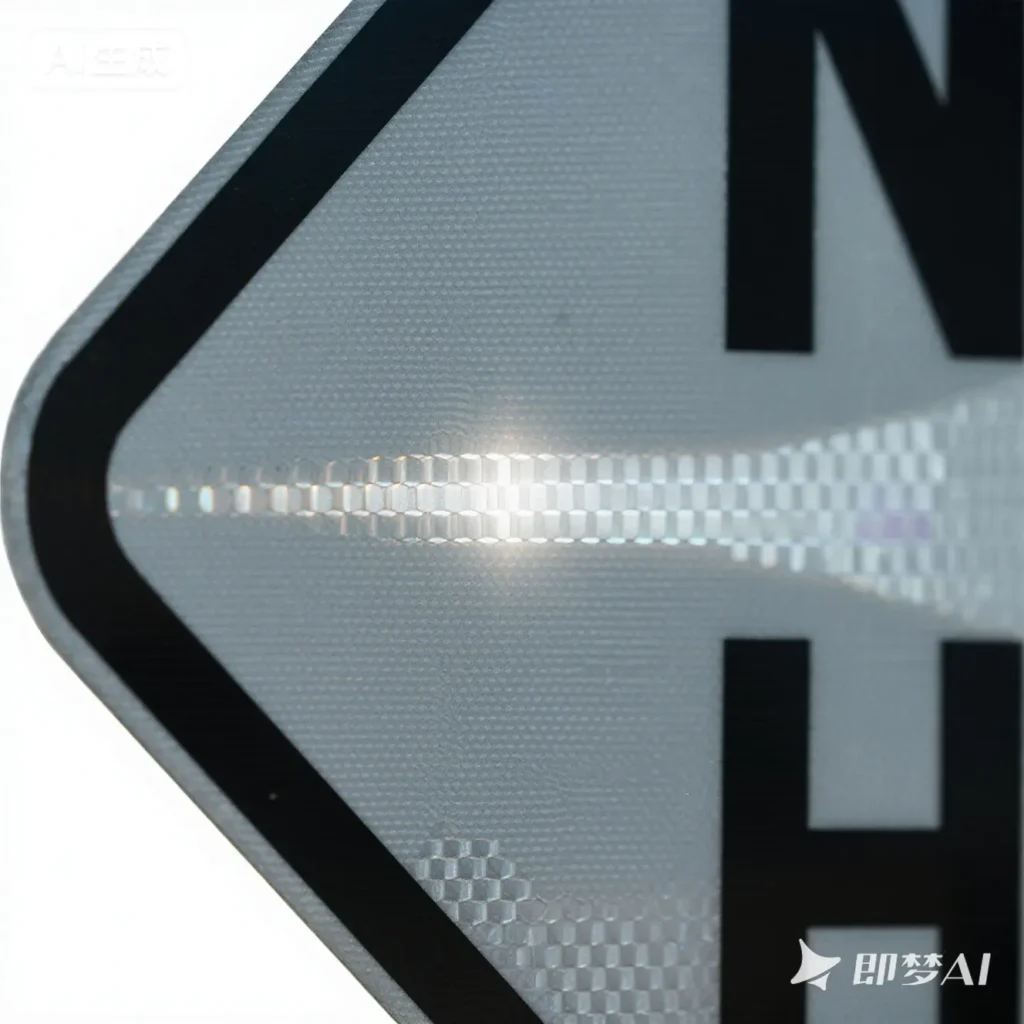
The “DG3” name is strongly associated with 3M’s Diamond Grade DG³ Reflective Sheeting Series 4000, a premium road sign sheeting line used by transportation agencies around the world. The “Diamond Grade” part refers to the high-performance prismatic class, while “DG³” indicates a third-generation diamond-grade technology with improved optics compared with older reflective materials.
In simple terms, DG3 is built to solve a visibility problem: as vehicles move faster, signs get larger, and drivers sit higher or farther from sign faces, lower-grade sheeting may not return enough light to the right viewing position. DG3 improves that by using microprisms that capture and return more light from headlights.
This matters especially for:
- overhead highway signs
- large guide signs
- high-speed roads
- signs mounted high above the road
- roads with heavy truck traffic
- complex intersections and interchanges
- critical warning signs
A normal sign can look acceptable in daylight but underperform badly at night. DG3 is used where nighttime legibility, wide-angle performance, and long-range recognition are not optional.
DG3 is not simply “brighter reflective film.” It is a premium microprismatic traffic sign sheeting designed to improve sign visibility under demanding nighttime driving conditions.
How Is Diamond Grade Different From High Intensity Prismatic Reflective Sheeting?
This is one of the most important comparisons for buyers because both materials are prismatic, but they are not the same performance class.
High Intensity Prismatic (HIP) sheeting is a mid-to-high performance reflective material commonly used for standard regulatory and warning signs, while Diamond Grade DG3 is a premium prismatic sheeting designed for higher brightness, better long-distance legibility, and stronger wide-angle performance. DG3 is usually chosen when standard HIP may not provide enough visibility for large signs, overhead signs, or high-speed roads.
The difference starts with the optical structure. High Intensity Prismatic sheeting uses microprismatic or encapsulated lens technology that provides much better brightness than older engineer grade sheeting. It is suitable for many road signs and is often the standard choice for municipalities, contractors, and sign shops.
Diamond Grade DG3 goes further. Its cube-corner optical system is engineered to return more light over a broader range of entrance and observation angles. This is why DG3 performs especially well when:
- the sign is mounted high
- the driver is viewing the sign from a lower or offset position
- trucks and passenger cars need to read the same sign
- the sign is large and positioned away from the lane
- road speeds are high
- early recognition distance matters
A useful way to think about it:
- Feature High Intensity Prismatic Diamond Grade DG3
- Performance tier Mid-high Premium
- Common ASTM range Type III / Type IV Type IX / Type XI class
- Brightness High Very high
- Wide-angle visibility Good Excellent
- Best use Standard road signs Overhead, large, critical signs
- Cost Lower Higher
- Buyer concern Meets common specs Worth the premium for demanding specs
That last row matters. DG3 costs more, so it should not be specified blindly for every sign. For low-speed roads, parking signs, or small signs at close viewing distance, High Intensity Prismatic may be enough. But when signs are large, mounted high, or used on fast roads, DG3’s extra brightness can directly improve safety and readability.
The main advantage of DG3 over High Intensity Prismatic is not just higher face-on brightness — it is stronger visibility at wider viewing angles, which is especially important for overhead signs and truck-driver sightlines.
When Should Buyers Choose Diamond Grade DG3 for Traffic Signs?
Diamond Grade DG3 is best used when sign visibility is mission-critical and lower-grade sheeting may not provide enough nighttime performance.
Buyers should choose Diamond Grade DG3 for overhead guide signs, large highway signs, high-speed roads, complex intersections, critical warning signs, and locations where signs must remain bright at long distances or wide viewing angles. It is usually not necessary for every low-speed or low-risk sign, but it is often the right choice when safety, compliance, and long service life matter more than the lowest material cost.
Here are the most common applications where DG3 makes sense:
Overhead guide signs. These are usually mounted high above the roadway. Because the headlight beam and driver’s eye line hit the sign at a challenging angle, wide-angle retroreflectivity matters. DG3 helps keep the sign readable for both passenger cars and trucks.
Large highway direction signs. Bigger signs often need to be read from farther away. The longer the required reading distance, the more valuable high-performance sheeting becomes.
Critical warning signs. Sharp curves, work zones, school zones, merging lanes, and accident-prone areas benefit from higher visibility, especially in poor weather or low-light conditions. High-speed roads. At 100 km/h or 65 mph, drivers have less time to recognize, read, and respond. A brighter sign gives drivers earlier recognition time.
Locations with mixed vehicle heights. Truck drivers, SUV drivers, and passenger car drivers view the same sign from different eye heights. DG3’s wide-angle performance helps the sign stay visible across different vehicle types.
However, buyers should avoid over-specification. If the application is a small parking sign, a low-speed private road sign, or a short-distance warehouse marker, DG3 may be unnecessary. In those cases, Engineer Grade or High Intensity Prismatic sheeting can be more cost-effective.
The best decision is application-based:
- Use Engineer Grade for low-speed, non-critical signs.
- Use High Intensity Prismatic for most standard road signs.
- Use Diamond Grade DG3 for large, overhead, high-speed, or critical safety signs.
DG3 should be treated as a performance upgrade for demanding sign locations, not as a universal replacement for all reflective sheeting grades.
What Should You Check Before Buying DG3 or Diamond Grade Alternatives?
The term “diamond grade” is sometimes used loosely in the market, so buyers need to verify the actual performance behind the label. Before buying DG3 or a diamond-grade alternative, buyers should check the ASTM D4956 type, retroreflectivity test data, outdoor durability rating, adhesive performance, warranty terms, and whether the supplier can provide valid documentation such as a 3M 4090 datasheet, equivalent test reports, or third-party certification.

Start with the exact product identity. If the buyer wants original 3M DG3, the supplier should clearly state the series and product code, such as 3M Diamond Grade DG³ Reflective Sheeting Series 4000 or related product numbers like 4090 white sheeting. Ask for the latest official data sheet, batch information, and warranty terms.
If the buyer is considering a diamond-grade alternative, the key question becomes: does it truly match the required performance class? Many suppliers describe their product as “diamond grade” or “DG grade,” but that does not automatically mean it meets the same ASTM type or wide-angle performance as 3M DG3.
Check these points carefully:
- ASTM D4956 type designation. Ask whether the product meets Type IX, Type XI, or another specified type. Do not rely on “diamond grade” as a standalone claim.
- Retroreflectivity values. Request measured values in cd/lx/m² at standard observation and entrance angles. If the supplier cannot provide numbers, the claim is not verifiable.
- Wide-angle performance. DG3’s value is strongly tied to performance at difficult angles. Ask for test data beyond basic face-on brightness.
- Outdoor durability. Premium reflective sheeting is often expected to last 10–12 years or more, depending on climate and installation conditions. Ask for weathering data and warranty details.
- Adhesive and application compatibility. Premium sheeting still fails if the adhesive is poor or incompatible with the sign substrate. Confirm the adhesive type, application temperature range, and substrate requirements.
- Supplier reliability. For importers and sign makers, verify export history, quality control process, lead time, sample consistency, and after-sales support.
Price is another important signal, but not the only one. Original 3M DG3 is usually expensive. Alternative diamond-grade products may be more affordable, but the price gap should be supported by transparent test data, not vague claims.
If a supplier claims “same as DG3” but cannot provide ASTM type data, retroreflectivity values, and weathering documentation, the product should be treated as unverified.
Conclusion
Diamond Grade DG3 means a premium class of microprismatic reflective sheeting designed for traffic signs that require maximum visibility, strong wide-angle performance, and long-term outdoor durability. It is best known through 3M’s Diamond Grade DG³ Series 4000, but the phrase “diamond grade” is also used more broadly in the market for high-performance prismatic sheeting.
For buyers, the important point is not the name alone. The real value of DG3 lies in where and why it is used: overhead signs, large guide signs, high-speed roads, critical warning signs, and applications where drivers need to read signs earlier and from wider angles.
If you are buying original 3M DG3, verify the exact series, product code, datasheet, and warranty. If you are considering an alternative diamond-grade supplier, verify ASTM type, retroreflectivity values, wide-angle performance, durability data, adhesive quality, and supplier reliability before placing a volume order.
[External links recommendation]
3M Diamond Grade DG³ Reflective Sheeting
ASTM D4956 Standard Specification for Retroreflective Sheeting
FHWA Retroreflectivity Information
FAQs
What is 3M DG3?
3M DG3 refers to 3M Diamond Grade DG³ Reflective Sheeting, a premium microprismatic traffic sign sheeting designed for high nighttime brightness, wide-angle visibility, and long service life. It is commonly used for overhead guide signs, large highway signs, and critical road safety signs where lower-grade sheeting may not provide enough performance.
What does 3M reflective mean?
“3M reflective” usually means a reflective material manufactured by 3M, such as reflective sheeting for traffic signs, reflective tape for vehicles, or reflective materials for safety apparel. In road signage, it often refers to 3M’s retroreflective sign sheeting products, including Engineer Grade, High Intensity Prismatic, and Diamond Grade DG3.
Is Diamond Grade the same as High Intensity Prismatic?
No. Both are prismatic reflective materials, but Diamond Grade is generally a higher performance class than High Intensity Prismatic. High Intensity Prismatic is commonly used for standard road signs, while Diamond Grade DG3 is used for larger, higher, faster-road, or safety-critical signs that require stronger brightness and wider-angle retroreflectivity.
How long does Diamond Grade DG3 reflective sheeting last?
Premium diamond-grade reflective sheeting is commonly rated for around 10–12 years or more, depending on product series, color, climate, installation quality, and exposure conditions. Buyers should always check the manufacturer’s official warranty and weathering data rather than relying only on general lifespan claims.
What is the price of 3M retroreflective sheet?
The price of 3M retroreflective sheeting depends on the product series, grade, color, roll size, order volume, and region. 3M Diamond Grade DG3 is usually one of the highest-priced traffic sign sheeting options because of its premium optical performance and long-term warranty. For procurement, buyers should compare price together with ASTM type, tested retroreflectivity, durability, warranty, and application requirements.