

Glass bead reflective sheeting is one of the classic reflective material technologies in the traffic safety and industrial marking market. Even though prismatic products have become more common in many higher-performance applications, glass bead sheeting remains relevant in the market because it can still offer a practical combination of visibility, process familiarity, and cost control for selected applications. The real procurement question is not whether glass bead sheeting is old technology. The real question is whether it is still the right technology for the job.
In practical terms, glass bead reflective sheeting uses embedded or enclosed glass beads to return light toward its source. It is commonly used in traffic signs, temporary markings, commercial graphics, and selected industrial applications where moderate reflective performance may be sufficient.
This is why buyers should not dismiss glass bead reflective sheeting too quickly, but they also should not choose it by habit. The smarter approach is to compare it with prismatic alternatives in terms of road environment, sign importance, durability target, and total project economics.
Glass bead reflective sheeting is still a valid choice when the project requires reasonable reflectivity and controlled cost, but it should not be treated as equal to higher-performance prismatic products in demanding traffic conditions.
What Is Glass Bead Reflective Sheeting and How Does It Work?
The name describes the core technology: tiny glass beads are used to return incoming light back toward the source.
Instead of relying on a prismatic optical structure, glass bead reflective sheeting uses spherical glass elements embedded in the material to create retroreflection when illuminated by headlights or other directed light sources.
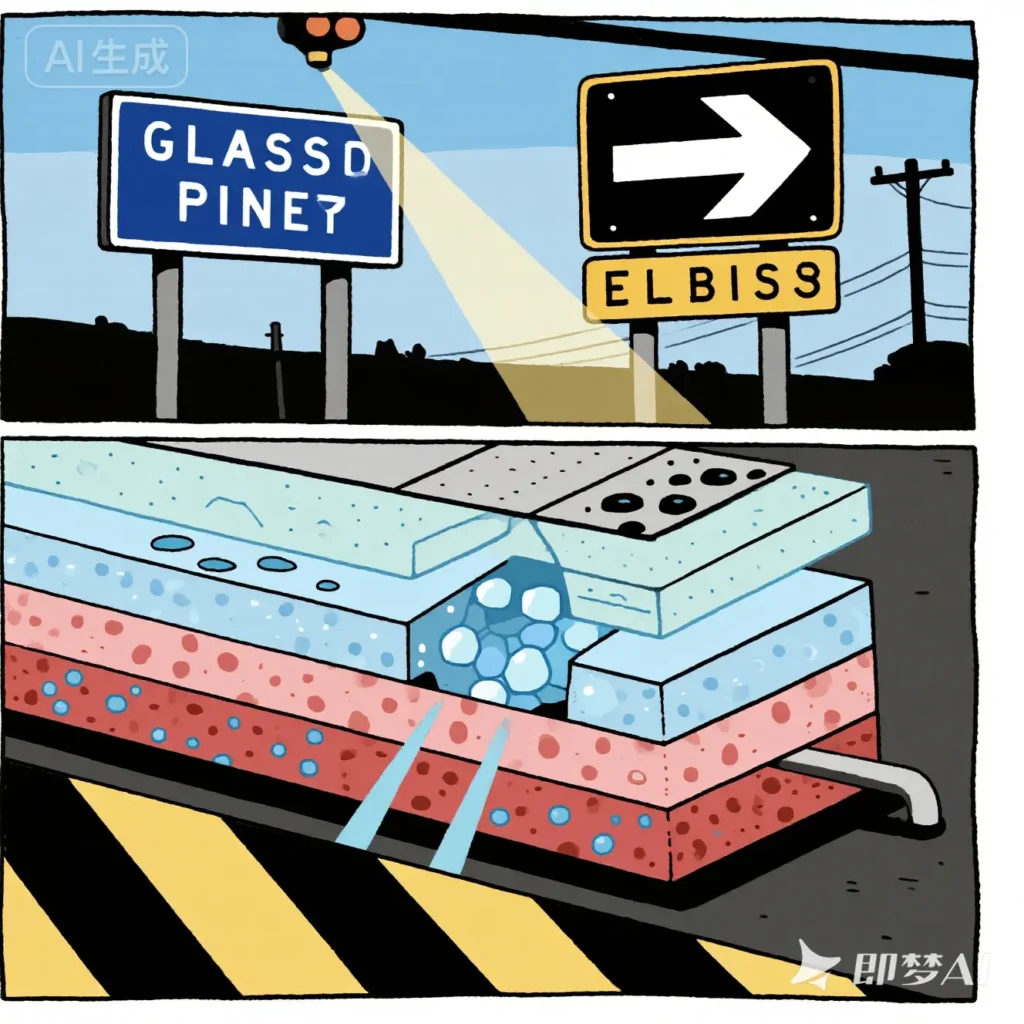
Glass bead reflective sheeting works by using thousands of small glass spheres that help redirect light back toward the driver or observer. This technology has been used for many years in traffic signs and reflective safety products, and it remains widely recognized in the market.
From a buyer perspective, the important point is that glass bead sheeting is a real optical system, not just a coated colored film. However, its reflective behavior and overall performance are usually different from modern prismatic systems.
This difference affects several real-world outcomes:
- reading distance,
- brightness under certain angles,
- durability expectations,
- and suitability for different traffic environments.
That is why buyers should understand the optical principle in practical terms. It helps explain why glass bead sheeting still works well in some applications but is increasingly replaced in others.
- Glass bead sheeting uses spherical glass elements to create retroreflection.
- It is an established reflective technology with long market history.
- Its optical behavior differs meaningfully from prismatic sheeting.
How Is Glass Bead Reflective Sheeting Different from Prismatic Reflective Sheeting?
This is usually the most important comparison for buyers.
The general market difference is that glass bead sheeting is often used where moderate performance is acceptable, while prismatic sheeting is more often selected for higher visibility, longer reading distance, and more demanding road conditions.

In broad terms, prismatic reflective sheeting tends to provide stronger optical performance in many demanding traffic applications. That is one reason it has become dominant in higher-grade road sign materials. Buyers working on highways, major guide signs, or high-visibility projects often compare glass bead options against prismatic alternatives for exactly this reason.
That does not mean glass bead sheeting is obsolete. It means its use should be more intentional.
Glass bead products may still make sense where:
- traffic speed is lower,
- visibility demand is moderate,
- project budgets are tighter,
- conversion familiarity matters,
- or the application is not a premium road-sign environment.
For procurement teams, the key point is to avoid a simplistic assumption that all reflective sheeting performs similarly. The optical structure matters, and that structure affects where the material should be used.
- Prismatic sheeting generally offers higher performance in demanding traffic conditions.
- Glass bead sheeting can still be valid where application demands are lower.
- Optical structure should be part of any serious buying decision.
When Is Glass Bead Reflective Sheeting Still the Right Choice?
Glass bead reflective sheeting is still chosen in many real-world projects, but usually for specific reasons rather than for maximum performance.
It is often the right choice when buyers need workable reflective performance, familiar conversion behavior, and cost efficiency for lower-demand road, commercial, or industrial applications.

In my view, glass bead sheeting remains most practical when the project priorities are:
- acceptable visibility,
- acceptable durability,
- and controlled cost.
Typical applications may include:
- municipal or local traffic signs,
- temporary or lower-demand road signs,
- commercial reflective graphics,
- warehouse or facility safety signs,
- and some industrial labeling or guidance uses.
It can also remain attractive in markets where buyers are familiar with the technology and where the application does not justify the cost increase of higher-grade prismatic materials.
However, buyers should think carefully before choosing glass bead products for:
- high-speed roads,
- critical warning environments,
- long-distance guide signs,
- or projects where premium-grade performance is expected.
The right question is not whether glass bead sheeting is “good enough” in theory. The right question is whether it is good enough for this exact project.
- Glass bead sheeting still has a valid role in selected cost-sensitive or moderate-demand applications.
- It should be matched to project conditions rather than chosen by habit.
- Lower-demand environments are usually where it remains strongest.
What Should Buyers Check Before Ordering Glass Bead Reflective Sheeting?
Because the market contains both solid and weak glass bead products, buyers need more than a simple product label to make a safe decision.
Before ordering, buyers should verify reflectivity level, intended application, durability target, compliance relevance, and supplier consistency—not just whether the film contains glass beads.

If I were sourcing glass bead reflective sheeting, I would begin with five checks.
1. Confirm the intended use
Is it for traffic signs, commercial graphics, temporary signs, industrial safety, or another application category?
2. Review performance expectations
Ask how the material performs relative to the visibility demand and whether it is intended as an economy product or a stable mid-level option.
3. Check durability claims
Ask for outdoor life expectations, weather resistance information, and limitations under long-term exposure.
4. Review compliance and specification fit
Does the project require ASTM, EN, ISO, or local road authority references that the product must satisfy?
5. Evaluate supplier quality
Can the supplier provide consistent batches, clear documentation, and honest comparison against prismatic alternatives?
This final point matters a lot. Some suppliers market glass bead sheeting as if it is interchangeable with higher-grade materials in every situation. Serious buyers should challenge that assumption early.
- Buyers should verify actual performance level, not just technology type.
- Compliance and durability matter even in lower-cost projects.
- A reliable supplier should explain where glass bead sheeting fits and where it does not.
Conclusion
Glass bead reflective sheeting remains an important material category because it can still deliver practical value in the right applications. Its long history, familiar conversion behavior, and cost advantages keep it relevant in many municipal, commercial, and industrial contexts.
But buyers should use it with clear intent. It is not automatically the best option simply because it is traditional or affordable, and it is not automatically equivalent to prismatic materials. The right sourcing decision comes from matching glass bead technology to the actual visibility demand, service environment, and project requirement.
- Technical bulletins from reflective sheeting manufacturers
- ASTM or EN references related to reflective sign materials
FAQs
1. What is glass bead reflective sheeting used for?
It is used for traffic signs, temporary signs, commercial reflective graphics, industrial safety signs, and other applications where moderate reflective performance may be suitable.
2. Is glass bead reflective sheeting better than prismatic sheeting?
Not in overall high-performance terms. Prismatic sheeting is usually stronger in demanding traffic applications, but glass bead sheeting may still be appropriate in lower-demand or cost-sensitive uses.
3. Is glass bead reflective sheeting outdated?
No. It is older technology, but it is not automatically outdated. It still has a role in the market when matched to the right application.
4. Can glass bead reflective sheeting be used for road signs?
Yes, depending on the type of road sign, road speed, required standard, and visibility demand. Buyers should confirm project fit before selecting it.
5. What should I ask a supplier before buying glass bead reflective sheeting?
Ask about intended application, reflectivity level, outdoor durability, standards relevance, and how the product compares with prismatic alternatives.