

What Is Reflective Sheeting Used For — and Why Does the Application Determine Which Type You Need?
Reflective sheeting is one of those materials most people see every day without thinking about it. Every traffic sign, highway guide panel, construction zone barrier, and truck reflective stripe depends on it. But for the people who actually buy, specify, or manufacture with reflective sheeting, the question isn’t just “what is it used for” — it’s “which type do I need for this specific use.”
Reflective sheeting is used for traffic signs, road guide panels, vehicle conspicuity markings, license plates, construction zone devices, guardrail delineators, and industrial safety signage. Each application has different visibility requirements, durability demands, and regulatory standards — which is why reflective sheeting is manufactured in multiple grades, from basic Engineer Grade (ASTM D4956 Type I) to premium Diamond Grade (Type IX/XI), each designed for a specific range of uses.
This article breaks down the major application categories, explains which reflective sheeting grade fits each one, and covers the standards and practical considerations that buyers and sign manufacturers need to get right before placing an order.
This article is written from hands-on experience in the reflective materials industry, working across traffic sign manufacturing, vehicle marking, and international procurement.
Why Is Reflective Sheeting Used on Traffic Signs — and Which Grade Fits Which Sign?
Traffic signage is the single largest application for reflective sheeting worldwide, and it’s also where grade selection matters most.
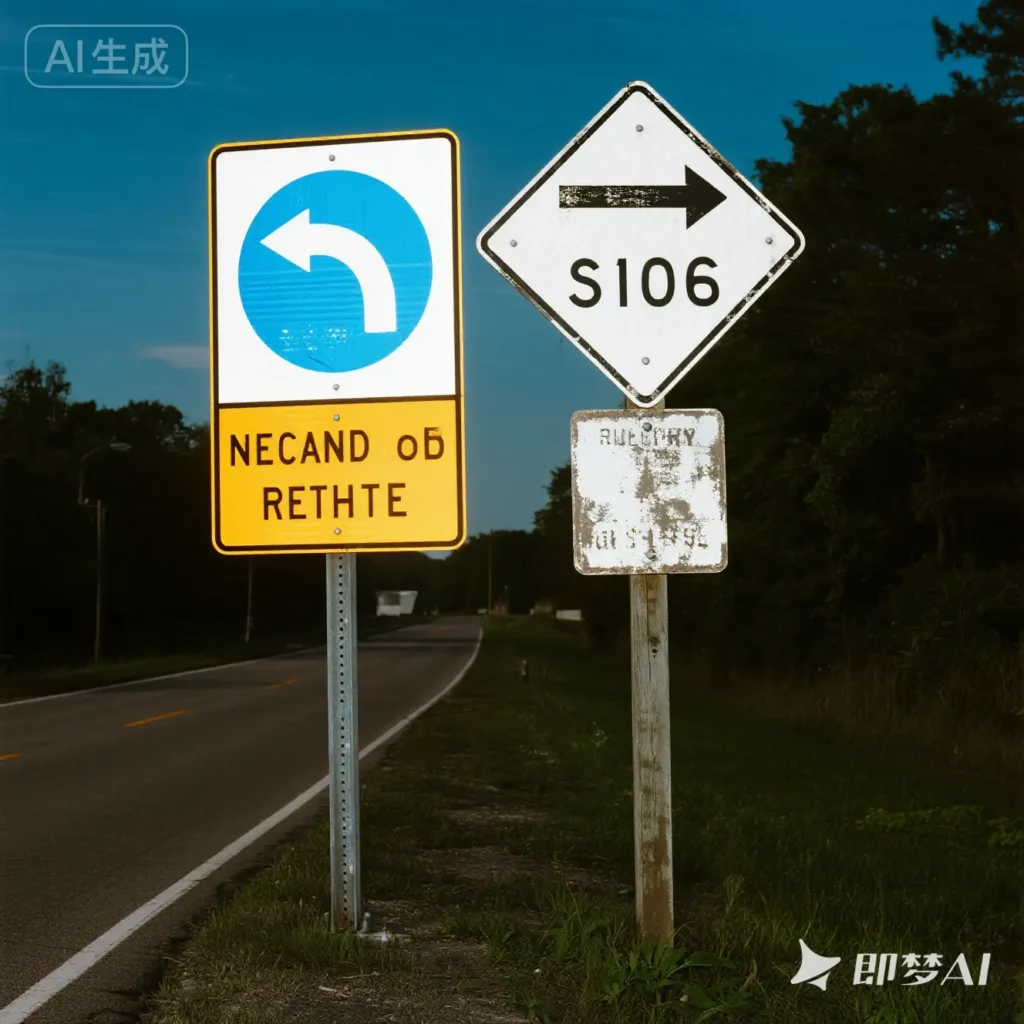
Reflective sheeting is used on traffic signs because retroreflective surfaces make signs visible at night by bouncing vehicle headlight beams back toward the driver’s eyes — without requiring external sign lighting. The grade of sheeting determines how far away the sign is readable, how well it performs at wide viewing angles, and how long it lasts outdoors.

Not every sign needs the same grade. Here’s how experienced sign manufacturers and transportation agencies match sheeting to sign type:
Residential and low-speed signs — Engineer Grade (Type I). Street name signs, parking restriction signs, property markers, and supplementary plaques on low-speed roads. These signs are viewed at close range and low speeds, so the baseline retroreflective performance of engineer grade is adequate. Typical outdoor life is around 7 years. This is the least expensive option and by far the highest-volume grade produced globally.
Highway regulatory and warning signs — High Intensity Prismatic (Type III/IV). Speed limit signs, stop signs, yield signs, curve warnings, and other regulatory signs on public highways. Most US state DOTs now specify HIP as the minimum acceptable grade for these signs. The brightness improvement over engineer grade — roughly 2–3x — means signs are readable from significantly greater distances, giving drivers more reaction time. Durability ratings are typically 10–12 years.
Overhead guide signs and critical warning signs — Diamond Grade (Type IX/XI). Large highway direction panels, freeway exit signs, overhead lane-use signs, and signs in complex interchange areas. Diamond grade sheeting is essential here because these signs are viewed from long distances, at high speeds, and often at steep vertical angles — especially by truck drivers sitting higher than passenger car drivers. Type XI (full cube) sheeting delivers the strongest wide-angle performance and is increasingly specified for these applications.
Construction and school zones — Fluorescent sheeting (Type VIII). Construction zone warning signs, temporary detour signs, and school zone signs benefit from fluorescent retroreflective sheeting, which combines daytime fluorescent visibility with nighttime retroreflection. The fluorescent orange or yellow-green color enhances conspicuity during dawn and dusk conditions, when standard retroreflective signs are least effective.
The FHWA maintains minimum retroreflectivity standards for traffic signs on US public roads. Signs that fall below these thresholds must be replaced — making initial grade selection a long-term cost decision, not just a purchase decision.
What Are the Non-Road Applications of Reflective Sheeting That Buyers Should Know About?
Traffic signs get most of the attention, but reflective sheeting is used across a wide range of industries and products — and many buyers underestimate how broad the market actually is.
Beyond road signs, reflective sheeting is used for vehicle conspicuity markings, license plates, industrial safety signage, marine navigation markers, airport runway signage, advertising signage, and personal safety products. Each application has its own performance requirements and, in many cases, its own regulatory standards.
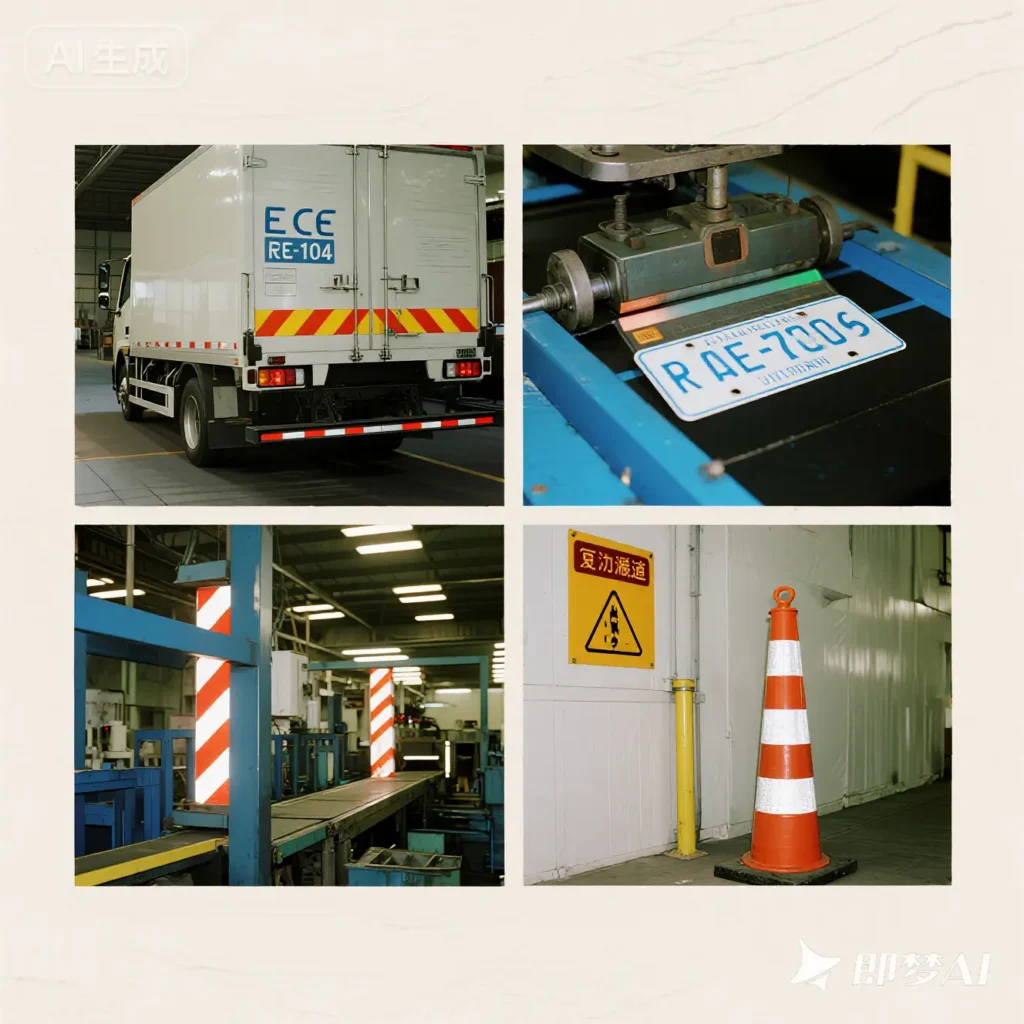
Vehicle conspicuity markings. Heavy trucks, trailers, and commercial vehicles in most countries are required to carry retroreflective markings — typically alternating red and white strips on the rear and sides. In Europe and many international markets, this is governed by ECE R104 (UN Regulation 104). In the US, FMVSS 108 applies. The sheeting used for vehicle conspicuity tape must withstand road spray, temperature cycling, fuel and solvent exposure, and mechanical abrasion — requirements that go well beyond what static sign sheeting needs to handle.
License plates. Retroreflective sheeting is the base material for vehicle registration plates in most countries. License plate grade sheeting must deliver high retroreflectivity for nighttime plate readability by law enforcement and automated camera systems, while also accepting screen printing or hot stamping for characters and graphics. This is a specialized product line with its own standards — often country-specific.
Industrial and workplace safety. Reflective sheeting is used for safety signs, hazard markers, and wayfinding signage inside factories, warehouses, mines, and construction sites. These applications often require sheeting that performs well in low-light indoor conditions and withstands chemical exposure, dust, and mechanical impact. Engineer grade and high intensity prismatic grades are most common here.
Marine and aviation. Channel markers, buoys, runway edge markers, and taxiway signs use retroreflective sheeting to provide nighttime visibility without electrical power. These applications demand exceptional outdoor durability — often 10+ years in saltwater or high-UV environments.
Advertising and commercial signage. Reflective sheeting is sometimes used for commercial signs, building identification, and directional signage where nighttime visibility from vehicle headlights is desired. This is a growing niche, particularly for roadside business signs that need to be visible to passing traffic without external illumination.
Vehicle conspicuity tape and license plate sheeting together represent a significant share of the global reflective sheeting market — and both segments have stricter regulatory requirements than standard traffic sign sheeting.
How Long Does Reflective Sheeting Actually Last — and What Affects Its Lifespan?
Outdoor durability is one of the most common buyer concerns, and also one of the areas where manufacturer claims need the most scrutiny.
Reflective sheeting outdoor lifespan ranges from approximately 5–7 years for basic engineer grade to 12+ years for diamond grade, depending on the product quality, installation method, and environmental conditions. These are not guaranteed numbers — they represent typical performance under standard temperate conditions, and real-world results vary.
Here’s what actually determines how long reflective sheeting lasts in the field:
Sheeting grade and construction. Higher-grade microprismatic and full cube sheeting generally lasts longer than glass bead engineer grade. The sealed prismatic structure is less susceptible to moisture ingress and UV-induced degradation than exposed glass bead surfaces.
UV exposure. This is the biggest single factor. Signs in equatorial, desert, and high-altitude environments degrade faster than signs in temperate regions. South-facing signs receive more UV exposure than north-facing ones in the northern hemisphere. A 10-year rated sheeting may only deliver 7–8 years of acceptable retroreflectivity in a high-UV environment.
Color. Darker colors — particularly red and brown — tend to absorb more heat and UV radiation, accelerating degradation. White and yellow reflective sheeting typically retains retroreflective performance longer than red or green under the same conditions.
Adhesive and substrate quality. Reflective sheeting is only as durable as the bond between the sheeting and the sign substrate. Poor surface preparation, incorrect adhesive selection, or incompatible substrate materials can cause edge lifting, bubbling, or delamination long before the reflective layer itself fails.
Maintenance and cleaning. Signs exposed to road spray, industrial fallout, or biological growth (algae, mold) lose effective retroreflectivity faster — not because the sheeting has degraded, but because the surface is obscured. Regular cleaning can extend functional life significantly.
For buyers: the most reliable indicator of durability is not the manufacturer’s marketing claim — it’s the accelerated weathering test data (typically per ASTM G154 or equivalent) and the specific warranty terms. A manufacturer that offers a written 10-year warranty backed by test data is making a very different commitment than one that simply prints “10-year durability” on a brochure.
In high-UV environments (tropical, desert, high altitude), actual reflective sheeting lifespan can be 20–30% shorter than rated values. Buyers in these regions should factor environmental derating into their replacement planning.
What Standards and Regulations Govern Reflective Sheeting — and Why Should Buyers Care?
Standards compliance is the area where SERP results consistently fall short. Most competitor articles mention ASTM D4956 in passing but don’t explain why it matters to the buyer’s actual decision-making.
The primary standards governing reflective sheeting are ASTM D4956 (US and international), EN 12899 (Europe), and ECE R104 (vehicle conspicuity, international). These standards define minimum retroreflective performance, color requirements, durability criteria, and test methods — and compliance is typically mandatory for public road applications.

ASTM D4956 is the most widely referenced standard worldwide. It classifies reflective sheeting into types (Type I through Type XI) based on minimum retroreflective performance at standardized observation and entrance angles. It also specifies color (chromaticity), adhesion, and weathering requirements. Most US state DOTs and many international transportation agencies base their sign specifications directly on ASTM D4956 type numbers.
EN 12899 is the European standard for fixed road traffic signs, including retroreflective performance requirements. It uses the RA classification system — RA1 (roughly equivalent to ASTM Type I), RA2 (roughly Type III/IV), and RA3 (roughly Type IX/XI). European tenders and sign contracts typically reference EN 12899 RA classes rather than ASTM types.
ECE R104 (UN Regulation 104) governs retroreflective markings for heavy vehicles — the conspicuity tape stripes on trucks and trailers. It specifies performance classes, color requirements, and test methods specifically for vehicle-applied retroreflective materials. Compliance is mandatory in the EU and most countries that follow UN vehicle regulations.
Why this matters for buyers: If you supply signs for a US DOT project that specifies “ASTM D4956 Type IV” and your sheeting only meets Type I, the signs will be rejected at inspection.
If you supply vehicle conspicuity tape to a European market without ECE R104 certification, the product is not legally compliant for its intended use.
If your customer operates under EN 12899 and you quote an ASTM type number without confirming the RA equivalence, you risk delivering material that doesn’t meet the contract specification.
The practical takeaway: always confirm which standard governs your specific project before selecting or quoting reflective sheeting. And always request test data that verifies compliance against the specific standard — not just the manufacturer’s general product claim.
Standards compliance is not optional for public road and vehicle safety applications. Non-compliant reflective sheeting creates inspection failure risk, contract liability, and — in the worst case — safety liability if signs or markings don’t perform when drivers need them.
Conclusion
Reflective sheeting is used across a remarkably broad range of applications — from highway overhead signs to truck conspicuity tape to license plates to industrial safety markers. But the critical insight for buyers and specifiers is that the application determines the grade, and the grade determines the standard you need to meet.
Choosing the right reflective sheeting is not a generic decision. It requires matching the specific application — sign type, mounting height, viewing distance, traffic speed, environmental exposure — to the correct ASTM D4956 type or EN 12899 RA class, and then verifying that the product you receive actually meets that standard through test data and, ideally, independent measurement.
If you get this process right, reflective sheeting is one of the most cost-effective safety materials in the transportation industry. If you get it wrong, you end up with signs that fail inspections, markings that don’t protect drivers, and materials that need premature replacement.
ASTM D4956 Standard Specification
FHWA Minimum Retroreflectivity Requirements
UN ECE R104 Vehicle Conspicuity Markings
EN 12899-1 Fixed Road Traffic Signs
FAQs
What is reflective sheeting and how does it work?
Reflective sheeting is a retroreflective material applied to the face of signs, vehicle markings, and safety devices. It works by redirecting light from vehicle headlights back toward the driver’s eyes using embedded optical elements — glass beads in engineer grade, microprismatic structures in higher grades, or full cube corner prisms in diamond grade. This retroreflective effect makes signs and markings visible at night without requiring external illumination.
What are the rules for reflective tape on vehicles?
In most countries, heavy commercial vehicles (trucks, trailers, semi-trailers) are required to carry retroreflective conspicuity markings. In Europe and countries following UN regulations, ECE R104 defines the performance classes, colors (red and white or yellow), placement positions, and minimum retroreflective values. In the US, FMVSS 108 governs vehicle conspicuity requirements. The tape must be tested and certified to the applicable regulation before it can be legally sold for vehicle use.
What is the difference between engineer grade and high intensity prismatic reflective sheeting?
Engineer grade (ASTM D4956 Type I) uses glass bead technology and provides baseline retroreflective brightness — suitable for low-speed roads, parking signs, and property markers. High intensity prismatic (Type III/IV) uses microprismatic or enclosed lens technology and is roughly 2–3x brighter, with better wide-angle performance and longer outdoor durability (10–12 years vs. 7 years). Most highway departments now require HIP as the minimum grade for regulatory and warning signs on public roads.
Can reflective sheeting be used for non-traffic applications?
Yes. Reflective sheeting is widely used for industrial safety signage, warehouse and factory wayfinding, mine safety markers, marine navigation aids, airport runway signage, and commercial roadside signs. The grade and adhesive type should be matched to the specific environment — indoor vs. outdoor, chemical exposure, temperature range, and required visibility distance. For non-traffic applications, engineer grade or high intensity prismatic are most commonly used.
How do I verify that reflective sheeting meets the required standard?
Request the manufacturer’s product data sheet with the specific ASTM D4956 type or EN 12899 RA class clearly stated. Ask for third-party retroreflectivity test reports showing measured values at standard angles (0.2° observation / −4° entrance for ASTM). For vehicle conspicuity tape, confirm ECE R104 certification. And before committing to volume purchases, test samples with a handheld retroreflectometer to independently verify that the material performs at the claimed level.